 Oahu Dolphin Tour
Can You See Dolphins From Shore on Oahu for Free?
Anyone who types swim with dolphins Oahu free into a search bar deserves a straight answer, and here it is: you can watch, free, from the shore, on a good morning. You can never legally swim out to them, from a beach or from a boat. Those two facts sit next to each other on this island for a specific legal reason, not a marketing one, and understanding why changes how you plan the trip, whether that ends up being a sunrise walk on the west coast or a booked seat on one of the boats that does the swim legally.
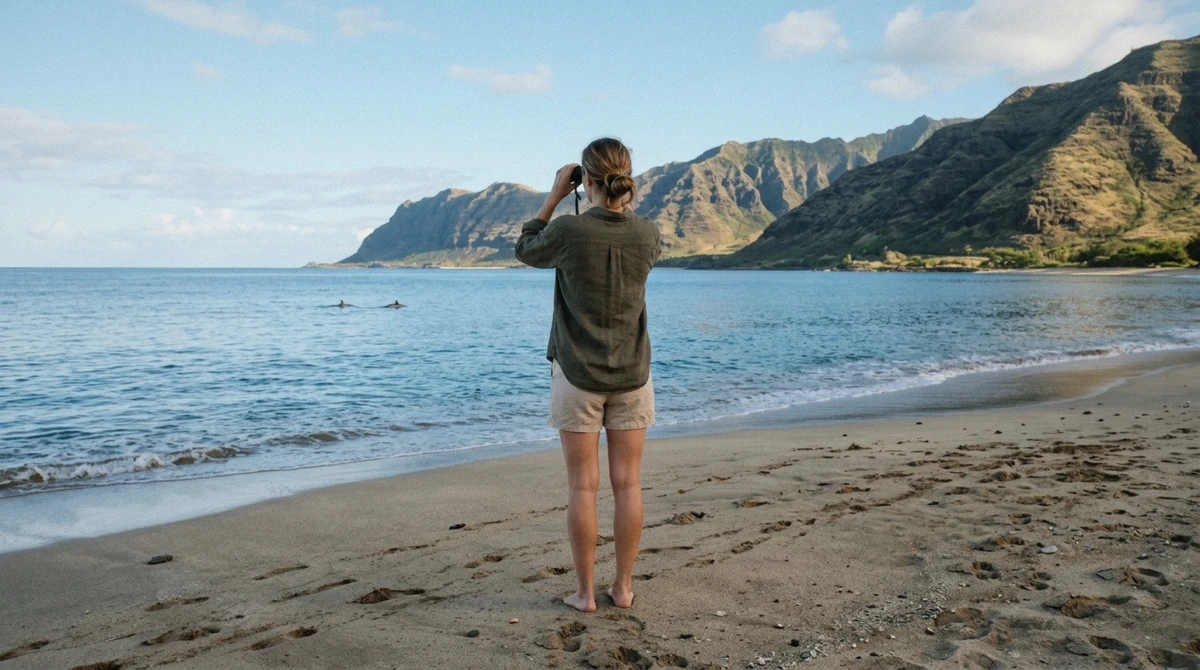
Quick answer
Yes, you can watch dolphins from Oahu's shore for free, and no, you can never legally swim out to them. On calm mornings, resting spinner pods surface a few hundred yards off the west coast and are visible with binoculars from public beaches and lookouts, no ticket required. Swimming toward them crosses the same 50-yard rule NOAA enforces on this coast, in water deep enough that unsupervised swims toward offshore pods are exactly how rescue callouts start. The honest qualifier: shore sightings are a maybe, not a guarantee.
Key takeaways
- Shore viewing costs nothing: spinner pods rest a few hundred yards off the west coast on calm mornings, no ticket needed
- Swimming out is illegal, not just risky. The same 50-yard rule explained in full here applies from a beach exactly as it applies from a boat
- Boat trips that do it legally run $174 to $193.88 per person; only the Dolphin Excursions swim boat puts that guarantee in writing
- Binoculars change the odds more than luck does. A phone camera zoom will not show you a dolphin at that distance
- West Oahu's beaches stay quieter than Waikiki's, which matters when you are standing still scanning open water for twenty minutes
The Honest Answer, First
Watch: yes. Swim: never
The two halves of this question have different answers because they are governed by different physics and, since 2021, by different law. Watching a pod from land costs nothing and breaks no rule, provided you stay on the beach. Swimming out to one is a federal violation regardless of where you start from, shore or boat, and it carries the same penalty either way.
The pods most visible from Oahu's west-side shoreline are Hawaiian spinner dolphins. They spend the night feeding in deep water offshore and come into shallow, sheltered west-coast bays during the day specifically to rest. That daytime resting behavior is why they show up close enough to see from land at all, and it is also the exact reason the law protects them from approach: a pod that gets pushed out of its resting bay repeatedly does not get the sleep it needs, and that has measurable effects on the population over time.
- Free and legal: standing on a public beach or lookout with binoculars, any distance
- Illegal from land or water: entering the water and closing the distance to a resting pod, at any speed, for any reason
Where and When Shore Viewing Works
The stretch that matters
Spinner dolphins favor the sheltered bays along Oahu's west coast, the same general stretch the swim and watch boats depart from. On a calm morning, a resting pod can surface a few hundred yards offshore, close enough to pick out with binoculars from a beach towel or a roadside pullout, far enough that a phone camera will show you nothing but glare on water.
This is not a scheduled show. Some mornings the surface stays empty the whole time you watch. Pods move, rest in a different bay, or simply aren't visible from the angle you have chosen. Treat a sighting as a real possibility on the right morning, not a promise the coastline owes you.
Timing beats everything else
Morning is the window that matters. Trade winds are lightest before the wind builds through the day, the water stays flatter, and the low sun angle over the Waianae range lights the surface instead of glaring off it. That combination is also why every boat on this coast, watch or swim, departs early rather than at midday. By late morning the same water that looked glassy at sunrise has a wind chop on it, and a resting pod that was easy to pick out against a flat surface disappears into the texture of the waves.
West-side beaches also run quieter than the stretch of coast around Waikiki, which helps in a practical way: fewer people, fewer parked cars, fewer distractions while you're standing still with binoculars trained on open water for the twenty or thirty minutes a real look actually takes. A crowded beach isn't dangerous for this purpose, it's just noisy in a way that makes patient scanning harder, and patience is most of what shore viewing actually requires.
One more timing note worth knowing before you set an alarm: shore viewing works off the same daily rhythm the boats are built around. Spinner dolphins feed offshore through the night and move into these sheltered bays specifically to rest once the sun is up, which is why a 6 or 7 a.m. arrival gives you a real shot and a 10 a.m. arrival mostly doesn't. The pods aren't hiding later in the day, they're often already resting somewhere you can't see from a fixed spot on land, or the glare and chop have simply made them impossible to pick out even if they're there.
- Real binoculars, not a phone zoom, are the single biggest factor in whether you see anything
- Go early. The window narrows fast once the trade winds pick up and the glare comes on
- Pick a spot with an unobstructed sightline to open water, not a beach tucked behind a reef break
- Bring patience for a no-sighting morning. It happens, and it is not a sign you picked the wrong spot
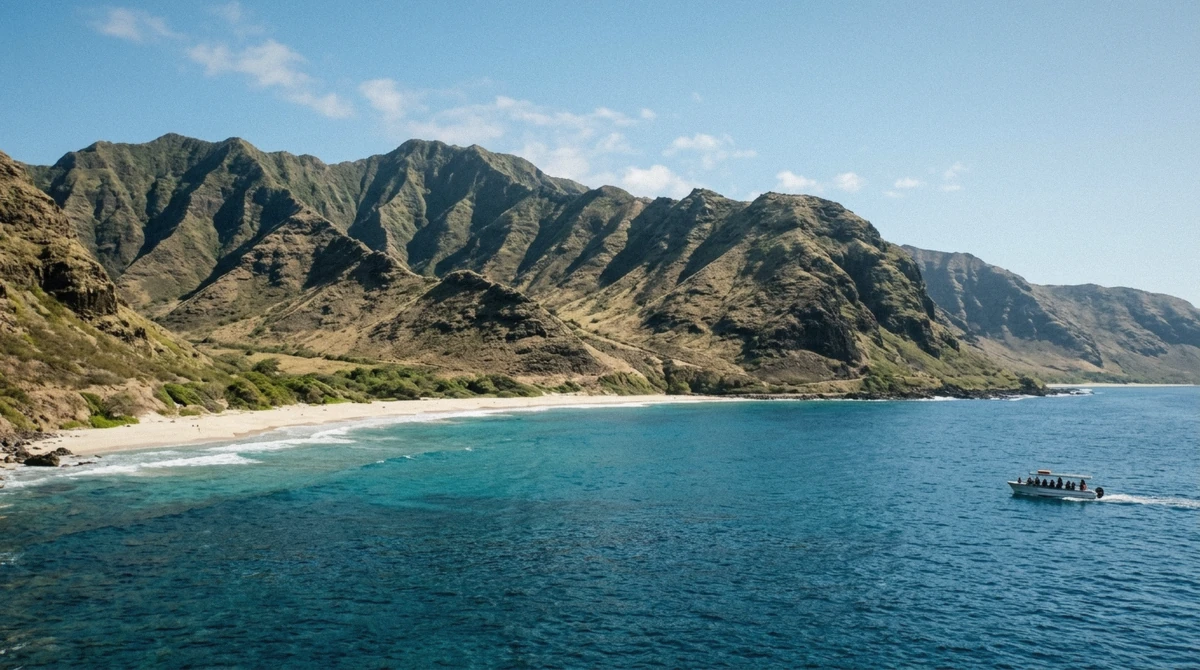
The west-side bays where resting pods pull in by day, close enough to watch, never close enough to swim.
Why Swimming Out Is Illegal, and a Bad Idea Either Way
The rule, in one paragraph
Since 28 October 2021, NOAA regulations under the Marine Mammal Protection Act have banned approaching a Hawaiian spinner dolphin within 50 yards, whether the approach comes by boat, kayak, drone, or swimming, and that includes swimming out from shore. NOAA enforces this on the west coast specifically, the same water where resting pods are most visible from land. There is no shore-based exemption.
Standing on the beach to look is legal; entering the water with the intent of closing the distance is the same violation as doing it from a boat.
The part the law doesn't have to explain
Even setting the rule aside, swimming out toward a pod you can see from shore is a bad plan on its own terms. The pods that are visible from land are typically a few hundred yards out, which does not sound far until you are the one swimming it, alone, in open water with no lifeguard tower watching that patch of coast and no boat crew tracking your position. Distance that looks manageable from a beach chair gets misjudged constantly by swimmers who have never covered it before, and the water gets deep fast once you're past the nearshore shallows.
This is close to the exact profile of an ocean rescue callout: someone who swam farther than planned, in deep water, past the point where turning back feels easy, with nobody onshore who knows they went in. None of that requires a dolphin to be dangerous on its own. It only requires an average swimmer to underestimate open ocean, which happens on this coast regularly enough that lifeguards and rescue crews treat unsupervised offshore swims as a known risk category, dolphins or not.
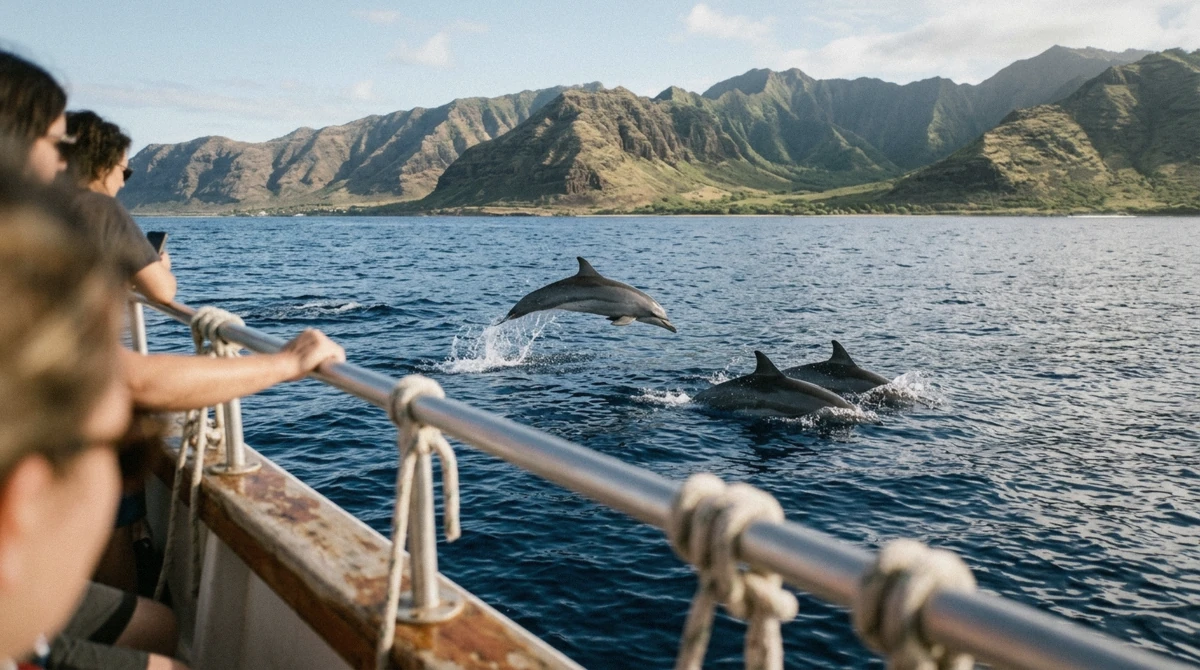
The pods sit far out in deep water: binocular distance from the sand, boat distance from everything else.
Free From Shore vs. Booking a Boat
What each option actually gets you
Reading this table left to right is the fastest way to see what you're trading off. Shore viewing costs nothing and asks nothing of you beyond an early alarm and a decent pair of binoculars. A boat costs real money and asks you to show up at a harbor before dawn, but it buys something shore viewing structurally cannot: legal access to the water itself, guided by a crew that knows the coast, on a platform built to find pods rather than hope one drifts into view.
| Free from shore | Booked boat | |
|---|---|---|
| Cost | $0 | $174 to $193.88 per person |
| What you get | A distant view on a good morning, no water access | In-water swim (spotted/bottlenose pods) or a close deck view of resting spinners |
| Odds of a sighting | Not guaranteed, weather- and timing-dependent | Higher; crews actively search the coast. Only the dolphin swim and turtle snorkel excursion in Waianae puts a written guarantee behind it |
| Legality | Legal to watch from land, any distance | Legal in-water swims target spotted, bottlenose and rough-toothed dolphins; spinners stay off-limits by the same 50-yard rule |
When the Boat Is the Right Call
If any of this sounds like your trip
Shore viewing is genuinely worth trying if you're on the west side anyway, willing to wake up early, and comfortable with a maybe. It stops being the right plan the moment an actual sighting matters to your trip, whether that's a single vacation day you don't want to gamble on, a request to actually get in the water, or a group that wants certainty over a free-but-uncertain morning.
| If this is you | Best option |
|---|---|
| you have one morning and don't want to risk seeing nothing | book the boat with the written sightings guarantee |
| you specifically want to be in the water with dolphins | book a swim tour; shore viewing can never legally include this |
| you're on a tight budget and happy with a possible sighting | try shore viewing first, on a calm morning, before dawn |
| you want the deck view without the swim | a watch-only boat is closer, calmer water and near-guaranteed proximity |
What the price actually buys
Every boat on this coast runs the same general water shore viewers are scanning, but from a platform with a crew whose entire job that morning is finding pods, plus, on the swim boats, legal access to get in the water with the species the rule doesn't cover. That combination, search plus legal water access, is the thing free shore viewing cannot replicate at any price, because the rule applies from a beach exactly as it applies from a hull.
A no-sighting morning free from shore costs you an early wake-up and nothing else. A no-sighting morning on a boat costs real money, which is why the one operator willing to guarantee sightings in writing, refunding for weather on top of it, stands out from the rest of the field. The full price comparison across all five boats, including which ones watch versus swim, sits in our tour comparison.
Questions About Seeing Dolphins for Free on Oahu
Can you see dolphins from the shore on Oahu?
Yes, on calm mornings resting spinner pods are sometimes visible a few hundred yards off the west coast, from public beaches and lookouts, at no cost. It isn't guaranteed on any given day.
Can you swim with dolphins from the beach on Oahu?
No. Swimming out toward a wild pod is illegal under the same federal 50-yard rule that governs boats, whether you enter the water from a beach or a hull. NOAA enforces this on the west coast specifically.
Where is the best place to see dolphins for free on Oahu?
The west coast bays that spinner dolphins use to rest during the day, the same general stretch the tour boats depart from, give the best odds. An unobstructed sightline to open water and an early arrival matter more than any single named beach.
What time of day are dolphins visible from shore?
Early morning, before the trade winds build. Flatter water and lower glare make a pod easier to spot, which is also why every boat on this coast, watch or swim, leaves at dawn rather than midday.
Do I need binoculars to see dolphins from shore?
Practically, yes. A resting pod a few hundred yards out is visible to the naked eye as small disturbances on the water, but binoculars are what actually confirm dolphins rather than waves or birds, and a phone camera zoom won't show you anything usable at that range.
Is it dangerous to swim out to dolphins on Oahu?
Yes, independent of the legal issue. The water past the nearshore shallows deepens quickly, there is typically no lifeguard watching that specific patch of coast, and swimmers routinely misjudge how far a few hundred yards actually is once they're in the water.
How much does a dolphin boat cost compared to free shore viewing?
Boats compared on this site run $174 to $193.88 per person, against $0 for shore viewing. The trade is certainty and legal in-water access versus cost. The full price breakdown covers every boat individually.